/ Listen to their testimonies
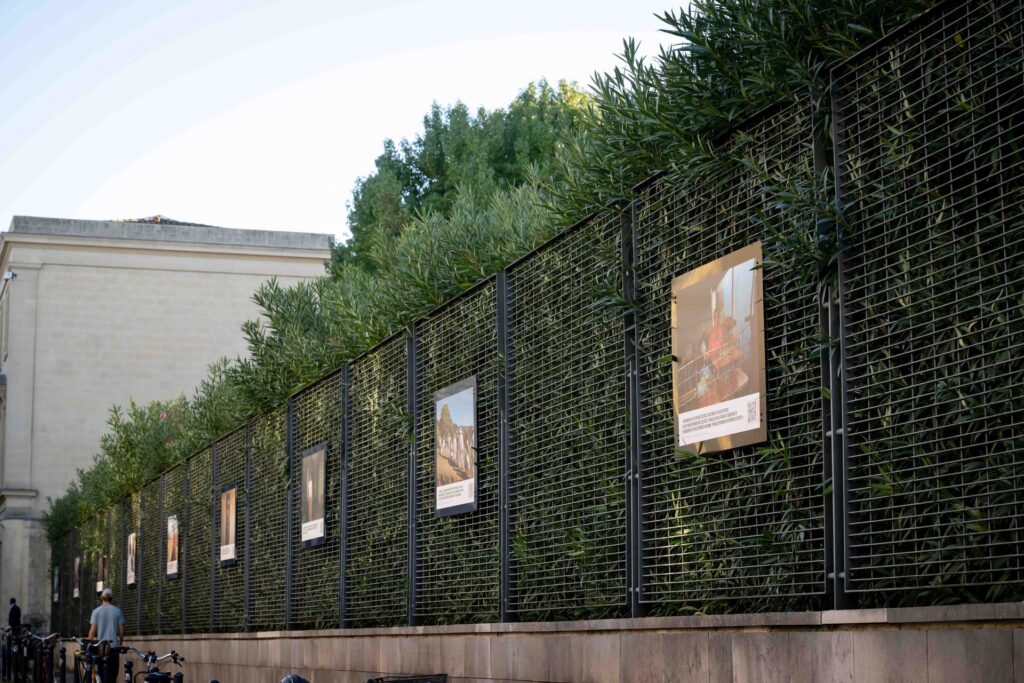
These voices accompany the panels of the exhibition.
🎧 For the best experience, use headphones or earphones.
Sylvia
Read the testimony
My name is Sylvia Acan, I am from Uganda and the mother of three children. Today, I stand before you as a survivor.
When I was 12 years old, my life changed forever. It was during the war. I was running with my sister to escape, when she was killed right in front of me. She was holding my hand. She was pregnant. The rebels captured me. That day, I lost my childhood.
I was enslaved, forced to carry burning food, to cook for those who oppressed us. If I slowed down, they threatened to kill me. One woman tried to escape… They killed her in front of us. “You’ll be next,” they told me. I was terrified.
Later, I gave birth to children born of that war. I suffered rejection and stigma. When you don’t know the father of your child, they say you bring misfortune. So, you leave, alone, with your baby.
But my story doesn’t end there. A man from my village reached out to me, helped me return to school, and I was able to study to become a social worker. Today, I am the founder of the organization Golden Women Vision. I work with passion, living my dream of supporting survivors and their children. I used to cry when I told my story. Now, I smile, full of gratitude.
I created a program specifically to give access to education for children born of rape during the war. Today, we have over 66 children born of rape enrolled in school, from primary to university. I proudly share that they are among the best-performing students. Education is the key to life. These children can change the destinies of their mothers—women who never had the chance to go to school. They can bring peace to our society. These children, once rejected, are our future.
But challenges remain. Social rejection from families and communities, lack of land access for women to build a home, no psychological support, no access to education or reparations, and more. Women carry all of this. And yet, we keep moving forward.
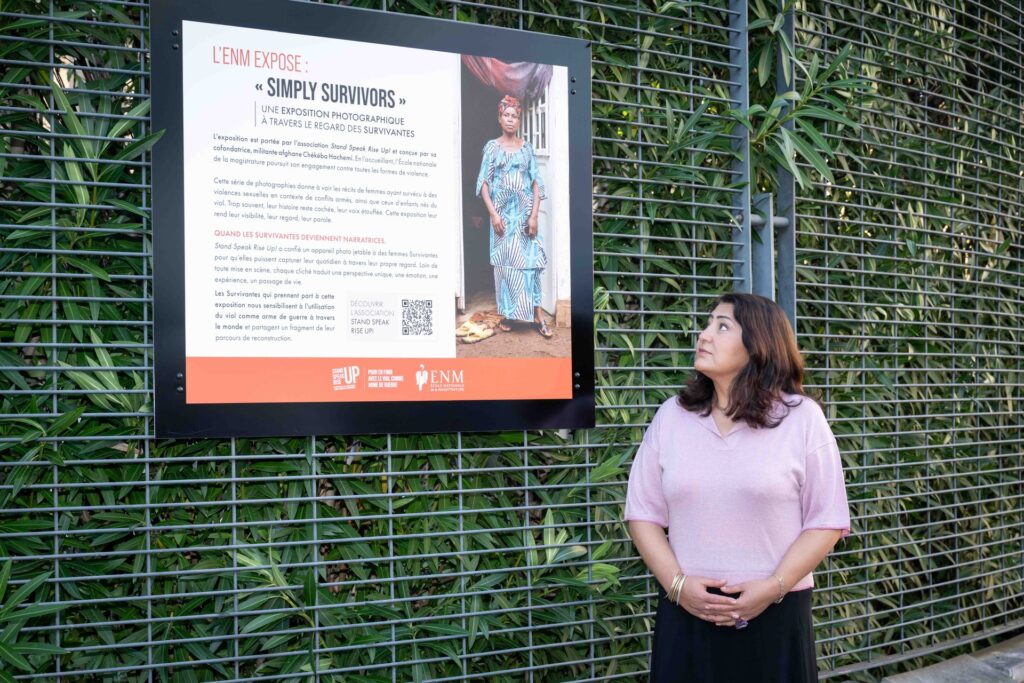
When I joined the Simply Survivors project, it was the first time survivors like me stood in front of the camera. We laughed, we smiled. I was touched by survivors and children shouting, “Yes, that’s my photo!” It was a moment of light.
This project gives a face to our struggle. We are here. We are alive. And we want to change our society. We must stay united and set an example for our children.
I have a dream: to build a free school for children born of rape. A safe space with a clinic where they can sleep, get medical care, and enjoy playful activities. I’m like a mother to them. They run into my arms shouting “Mama!” They know that if I can do it, they can too.
I call on the international community: do not turn your eyes away from conflict. Involve women in solving sexual violence. To bring peace, offer real psychosocial support to mothers and children. I know the world will change. A better tomorrow is coming.
Olena
Read the testimony
My name is Olena Suslova. I am 67 years old, and I am proud to be Ukrainian. For over 30 years now, I’ve been working in my organization, the Women Information Consultative Center, to defend human rights in Ukraine. In 2015, we began documenting violations related to the conflict that had broken out a year earlier. Out of 38 people interviewed that year, 6 had experienced conflict-related sexual violence. It was far more than I expected. I was deeply shaken. And one question became clear: how can we support Survivors?
But at the time, even the investigators from the Security Service had received little training. And the Survivors themselves lacked access to crucial information and support.
I remember one very particular day, it was April 10. I accompanied a Survivor to an interview. She was telling her story. That day, I realized how prepared I needed to be. To stay neutral, to support without breaking down, not to overreact in front of the investigators. When I got home, my whole body was tense. Every muscle was sore.
Then came February 2022. This full-scale war. In all its horror. A new need to act. Stronger. More urgent. Some of the Survivors, we already knew them. They had survived in 2014 and were raped again in 2022. Can you imagine? Twice. Or even more! It’s unbearable.
Thanks to my organization, we offered Survivors training in conflict management and assertiveness. We brought in psychologists, gynecologists, healthcare providers… But at first, the changes were slow, almost invisible.
And then… one day in November 2022, a colleague and I stopped. We watched. We listened. And we saw. Their faces had changed. Their clothes. Their way of speaking. There was something new. A light. A quiet, inner joy. A beginning of transformation.
I’m proud to have contributed to the publication of 10,000 copies of a guide for the police, the security service, NGOs, and Survivors. A valuable resource, with contacts, advice, and concrete tools. Because sometimes the approach must be personal. You must go to these women, even when they ask for nothing.
And that is the biggest challenge: how do we help those who never ask for help? Some are completely alone. They hold everything inside. They could ask for reparations… but they’re afraid. They need time. And there are also the children born of rape. The women who became pregnant after being raped… How do we support them? How do we help them rebuild?
People often ask me why I still do this work after all these years. I still don’t know. Maybe out of fair play. Maybe out of loyalty. But mostly because I know that Russia wants to annihilate Ukraine. And I want to resist. I have lost many loved ones. So maybe… it’s true that I’m trying to make up for some of that loss. By helping those who are still here.
When I look at the Survivors, I see their strength. I love them for who they are. I often say that those who have suffered are sometimes stronger than those who have never gone through anything. I truly believe in post-traumatic growth. And I wish that, one day, everyone who has lived through horror can access that growth.
But there are still many taboos: we speak so little about men. And yet… In the occupied territories, 80% of Ukrainian prisoners of war suffer sexual violence. Testimonies tell of rape with objects, torture, psychological terror.
In Ukraine, Survivors are between 4 and 82 years old. It defies understanding. Mothers, daughters, men, children… Anyone can become a Survivor. Anyone.
My message is simple: we only see danger when it is right in front of us. But even in the shadows, we must keep singing. Keep speaking. Keep sharing our voices with the world. Keep remembering who we are. I am proud of my culture. Of our embroidery. Of those who fight for the truth.
“One Ukrainian man, fightin’ evil again… Two Ukrainian men, fightin’ evil again… Three Ukrainian men and women, fightin’ evil again and winnin’… All Ukrainian men and women, fightin’ evil again and winnin’…”
I love singing this song. It helps me hold on. It tells our story. Our struggle. It’s a promise… that despite everything… Ukraine will live.
Mildred
Read the testimony
My name is Mildred, I come from Zimbabwe. I am the mother of two children: a 21-year-old boy and an 18-year-old girl, who is now a university student.
I am a survivor. I have been through violence, but I am still standing.
My path has not been easy. Rebuilding after what we have experienced takes much more than courage. Rehabilitation touches everything: the body, the mind, and social dignity. We, Survivors, need to be supported, accompanied, strengthened, to find our place in the world. One day, I met members of SEMA, a group that brings together survivors of conflict-related sexual violence from around the world. It was a turning point. That day, I understood that I was not alone. That elsewhere, beyond my borders, people cared about us and our struggle.
My greatest strength, I find it in my daughter’s eyes. She needs me. She is my pillar, my engine, the one who gives me the courage to move forward. Today, I am proud to say that she is pursuing her studies thanks to the support of Stand Speak Rise Up! Giving her a quality education is the most precious dream I can fulfill.
But the challenges weighing on survivors are immense. How can one rehabilitate the mind when struggling to feed one’s children? How to believe in the future when you cannot pay tuition fees, nor even buy clothes? In Zimbabwe, the economy is collapsing, prices change daily, NGOs are leaving the country, and many survivors don’t even have shelter.
Yet, despite everything, we survive. We work with our own hands. We hold on because we know there is life after. We remain human beings. We have lost part of our dignity, but we remain the same, and we refuse to be discriminated against.
In August 2025, I had the honor to receive in Uganda the Award for Reproductive Justice. I was told that I had fought for justice to the very end, and that my struggle was becoming a beacon of hope for other African countries that are finally starting to change their laws on reproductive rights.
My greatest dream today is to build a rehabilitation center for survivors. A place where we could meet, talk, play, share, and heal together. A place to become fully human again.
And my message is simple. Do not turn your eyes away from children born of rape. They exist. They did not choose to be born, but they deserve a future. Money will never restore our dignity. But support will. We don’t need pity. We need real help: a roof, food, access to rehabilitation.
With the other survivors, we meet every month. As long as we are still alive, we support each other. To survive, I do odd jobs, like cleaning. But what carries me is this conviction: we did not choose what happened to us. But we choose to survive, to rise, and to keep fighting.
Salimata
Read the testimony
My name is Salimata. I come from Guinea-Conakry, a country I left because my life there had become unbearable. Polygamy, violent arguments between my parents, daily fear: it was all suffocating me. I was a French teacher and believed in education as a means of emancipation, but teaching was not enough to protect me from instability and humiliation. So, I set off on my own, leaving behind everything I had, because I knew that if I stayed, I would have no future.
As soon as I arrived in Mauritania, my body was treated like prey. I was raped by a police officer, a man who was supposed to embody order and protection. As a result of this violence, I became pregnant. When I dared to report it, I thought I would find justice, but it was a trap. I was forced to stay in the country, trapped in procedures I did not understand, locked up in a space that was not mine, harassed by the authorities and exposed to further abuse. Even another police officer, the one who had promised to protect me, ended up raping me too. Shame and fear took root in my flesh, and I was already carrying the life of a child conceived in pain.
In Morocco, I believed for a moment that the sea could be my deliverance. But it almost became my grave. The boat that was supposed to take us to Spain was a small dinghy. We were crammed together, without water or food, and very quickly the boat began to take on water. Three days adrift, three days of cries, prayers and despair. I saw children fainting from exhaustion, women crying silently. I thought I was going to die, along with the child I was still carrying. When the Spanish ship appeared, it was as if the heavens had opened. But the trauma of those hours spent waiting for death never leaves me.
In Spain, then in France, I was just a shadow. In Barcelona, my phone, my papers and my train ticket were stolen. The small fragments of my identity that I had managed to save, were taken from me in that instant. I wandered alone, disoriented, hungry, humiliated, until two young people reached out and helped me get back on my feet. Without them, I might have remained stuck there, invisible, among the thousands of others lost in the crowd.
I finally reached Luxembourg on 23 December 2024. I arrived broken. I was hospitalised immediately. In February 2025, I gave birth. I was so exhausted that for a moment I thought I wouldn’t be able to keep this child. I thought about adoption, convinced that I was incapable of loving him, that I couldn’t give him the life he deserved. But when I saw him, when I held him in my arms, I knew that I had to be his mother, despite my doubts and my wounds. Today, we live together in a home. But I still wake up at night with a start, drenched in sweat, with flashes of the policeman who raped me, the sinking boat, the sea pulling me down.
Participating in the Simply Survivors exhibition is a way of breaking the silence that has suffocated me for too long. Through the photos of my daily life, I show that behind every forced smile or every mundane gesture, there is a story of survival. Being part of this exhibition means regaining some power over what I have endured. It is telling the world that we are not just numbers in migration statistics, that we are not just bodies thrown into the sea or used by men. We are women, mothers, survivors. My message is simple: look at us, listen to us, and never forget that every step we take is wrested from pain and courage.
/ Support Survivors
Since 2019, Stand Speak Rise Up! has supported projects led by Survivors themselves: medical care, psychological support, economic independence and schooling for their children. Your donation helps them rebuild their lives.